

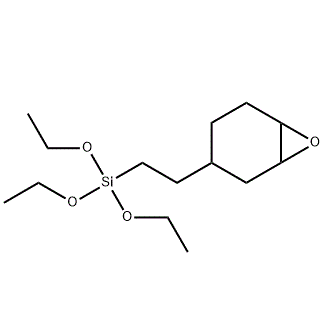
| CAS NO.10217-34-2 2-(3,4-Epoxycyclohexyl)ethyltriethoxysilane | |
| Product Name | 2-(3,4-Epoxycyclohexyl)ethyltriethoxysilane |
| Synonyms |
2-(3,4-EPOXYCYCLOHEXYL)ETHYLTRIETHOXYSILANE; triethoxy[2-(7-oxabicyclo[4.1.0]hept-3-yl)ethyl]-Silane;Silane,triethoxy2-(7-oxabicyclo4.1.0hept-3-yl)ethyl-;BETA-(3,4-EPOXYCYCLOHEXYL)ETHYLTRIETHOXYSILANE;triethoxy-[2-(Chemicalbook7-oxabicyclo[4.1.0]heptan-4-yl)ethyl]silane;Triethoxy-[2-(7-oxabicyclo[4.1.0]heptan-3-yl)ethyl]silane;(2-(7-Oxabicyclo[4.1.0]heptan-3-yl)ethyl)triethoxysilane;7-Oxabicyclo[4.1.0]heptane,3-[2-(triethoxysilyl)ethyl]- |
| CAS NO | 10217-34-2 |
| Appearance | Colorless liquid |
| Assay | ≥95.0% |
| MF | C14H28O4Si |
| MW | 288.46 |
| Product Categories | Silane reagent; Coupling agent; Organic silicon; Epoxy silane; Silane coupling agent; Chemical raw materials; raw material |
| Storage | Keep in dark place,Sealed in dry,Room Temperature |
| Capacity | Make to the order |
| Package | In paper drums /Fluoride drums /iron drums /plastic drums/IBC Tank ,etc. |
| Shipment method | By Sea ,Air ,Courier door to door ,etc. |
| Loading Port | China any port ,Beijing ,Shanghai ,Hong Kong etc. |
| Application | Used as a coupling agent. |
| Contact Information |
Name :Mr.Jack Chen E-mail :jack.chen@dakenchem.com |
Frequently Asked Questions:
Q:In which fields in CAS NO.10217-34-2 primarily used?
A:This product finds wide application across various industries:
1.The core function of this product is to serve as a coupling agent between the organic and inorganic phases.
2.A key feature of 2-(3,4-epoxycyclohexyl)ethyltriethoxysilane is its excellent compatibility and stability in aqueous systems, overcoming the drawback that traditional silane coupling agents are difficult to use in water-based environments.
3. 2-(3,4-Epoxycyclohexyl)ethyltriethoxysilane is highly valued in the electronics industry because it improves the electrical properties of epoxy-based encapsulants.
4. In sealants and adhesives, this product can serve as a primer or additive to enhance adhesion and overall performance.
Q:What specifications of 2-(3,4-epoxycyclohexyl)ethyltriethoxysilane can your company provide?
A: We supply industrial-grade and high-purity electronic-grade products with purity levels of 95.0% or higher. Specifications and impurity control standards can be customized to meet the specific requirements of industries such as fine chemicals, semiconductors,
and pharmaceuticals.
Application Cases
1.Surface Treatment of Composite Materials and Fillers
Field: Composite Materials / Glass Fiber Reinforced Plastics
Background Issues:
A composite materials manufacturer producing glass fiber-reinforced epoxy structural components (such as wind turbine blades and sports equipment parts) discovered that the interfacial bonding strength between the glass fibers and the epoxy resin matrix was insufficient. This resulted in low flexural strength and interlaminar shear strength—with a particularly marked decline in mechanical properties following hydrothermal aging—thereby compromising the long-term reliability of the products.
Solution:
Daken incorporates 2-(3,4-epoxycyclohexyl)ethyltriethoxysilane as a key component of the sizing agent during the surface treatment of glass fibers. A 1.5 wt% silane treatment solution is prepared using anhydrous ethanol as the diluent (with the pH adjusted to approximately 4 using glacial acetic acid to promote hydrolysis); glass fiber cloth is then impregnated with this solution, air-dried at room temperature, and cured at 110°C for 15 minutes. This process facilitates a condensation reaction between the triethoxysilyl groups of the silane molecules and the silanol groups on the glass fiber surface, forming strong chemical bonds, while the epoxycyclohexyl groups remain exposed on the fiber surface, ready to participate in the subsequent curing and cross-linking reactions with the epoxy resin.
Application Results:
Glass fiber-reinforced epoxy composites treated with this silane exhibited an increase in flexural strength of approximately 35% and an improvement in interlaminar shear strength of about 40%, alongside a marked enhancement in impact strength. Crucially, after 72 hours of immersion in boiling water, the strength retention rate of the treated samples rose from less than 50% to over 85%, demonstrating a significant improvement in interfacial water resistance.
2.Improvement of the Wet-State Electrical Properties of Electronic Potting Compounds
Field:Electronic Packaging / Epoxy Potting Materials
Background Issues:
An electronic component encapsulation enterprise utilized a traditional epoxy resin/anhydride curing system to produce potting compounds for outdoor LED drivers. After the resulting encapsulated components were stored for several weeks in a high-temperature, high-humidity environment (e.g., 85°C/85% RH), their volume resistivity dropped significantly and the dielectric loss tangent (tan δ) increased, leading to the deterioration of electrical performance and even leakage failures. Analysis revealed that the root cause of the problem was the degradation of the interface between the epoxy resin and the inorganic filler (silica powder) due to moisture ingress.
Solution:
Daken introduces 2-(3,4-epoxycyclohexyl)ethyltriethoxysilane during the filler pre-treatment stage for the potting compound. The specific process involves mixing silica powder filler with the silane in a high-speed mixer—using a silane dosage of 1.0–1.5 wt% relative to the filler mass—first blending at room temperature for 10 minutes, followed by heat treatment at 110°C for 1 hour to form a stable organic modification layer on the filler surface. The treated filler is then mixed with epoxy resin and a curing agent according to the original formulation to prepare the potting compound.
Application Results:
Potting compounds prepared using this silane-treated filler maintained a volume resistivity exceeding 10¹⁵ Ω·cm even after high-temperature, high-humidity aging—significantly higher than the 10¹³ Ω·cm level observed in samples using untreated filler. Furthermore, the magnitude of change in dielectric constant and dielectric loss before and after hygrothermal aging was reduced by approximately 60%. This silane improves the electrical performance of epoxy-based electronic packaging materials under humid conditions, particularly regarding key electrical parameters such as dielectric constant and volume resistivity.


