|
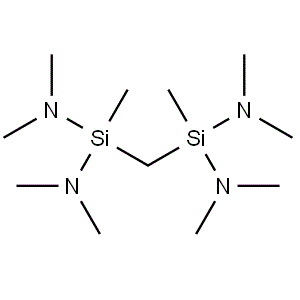
CAS NO.3103086-41-2 2,6-Diaza-3,5-disilaheptane-3,3,5,5-tetramine, N3,N3,N5,N5,2,3,5,6-octamethyl- |
|
|
Product Name |
2,6-Diaza-3,5-disilaheptane-3,3,5,5-tetramine, N3,N3,N5,N5,2,3,5,6-octamethyl- |
|
Synonyms |
2,6-Diaza-3,5-disilaheptane-3,3,5,5-tetramine, N3,N3,N5,N5,2,3,5,6-octamethyl- |
|
CAS NO. |
3103086-41-2 |
|
Appearance |
Colorless liquid |
|
Purity |
95% |
|
MF |
C11H32N4Si2 |
|
MW |
276.57 |
|
Storage |
Preserve in a well-closed container and keep in cool, dry place, avoid light. |
|
Package |
In fluoride bottle/ Fluoride drums/iron drums/plastic drums |
|
Shipment method |
By Sea, Air, Courier door to door, etc. |
|
Loading Port |
China any port, Beijing, Shanghai, Hong Kong etc. |
|
Application |
1,Precursors for Semiconductor and Electronic Materials Silicon Nitride Thin Films Silicon-Nitrogen-Carbon Ceramic Materials ALD/CVD Deposition Precursors Semiconductor Insulating Layer Materials
2,Ceramic Precursors High-Temperature Resistant Ceramics Aerospace Composite Materials Corrosion-Resistant Coatings Specialty Fibers
3,Cross-linking Agents and Functional Monomers Epoxy Resin Cross-linking Agents Polyurethane Modifiers Functional Monomers for Silicone Resins Specialty Polymer Intermediates |
|
Contact |
Contact person: Mr.Forrest Lee Email: forrest.lee@dakenchem.com |
Q1. What is CAS 3103086-41-2?
CAS 3103086-41-2 is a high-purity organosilicon amine compound containing Si–N bonds. It is commonly used as a precursor for advanced semiconductor materials and silicon-containing thin films.
Q2. What are the main applications of this product?
It is primarily used in semiconductor manufacturing, silicon nitride film deposition, advanced ceramic materials, and specialty organosilicon synthesis.
Q3. Can it be used as an ALD or CVD precursor?
Yes. Its silicon-nitrogen structure makes it a promising precursor for Atomic Layer Deposition (ALD) and Chemical Vapor Deposition (CVD) processes.
Q4. Why is it valuable for semiconductor applications?
The molecule provides both silicon and nitrogen sources, helping produce high-quality silicon nitride and related dielectric materials.
Q5. What purity grades are available?
Electronic-grade and customized high-purity grades may be supplied depending on customer requirements.
Application Case 1: Silicon Nitride Thin Film Deposition
Semiconductor Manufacturing
CAS 3103086-41-2 is used as a silicon-containing precursor in the deposition of silicon nitride (SiNx) thin films. These films serve as dielectric layers, diffusion barriers, and passivation coatings in advanced semiconductor devices.
The molecule contains both silicon and nitrogen functionalities, making it a promising precursor for producing high-quality films with controlled composition and excellent electrical performance.
Benefits
Silicon and nitrogen source in one molecule
Suitable for advanced thin-film processes
Potentially reduced contamination compared with traditional halosilane precursors
Supports high-purity semiconductor manufacturing
Application Case 2: Advanced ALD Process Development
Atomic Layer Deposition (ALD)
Research institutions and semiconductor material developers use CAS 3103086-41-2 when evaluating next-generation ALD precursors for nanoscale film growth.
As device geometries continue to shrink, conventional precursors may face limitations in conformality and film quality. Organosilicon amine compounds are increasingly investigated as alternatives for advanced deposition technologies.
Benefits
Suitable for precursor screening programs
Supports ultra-thin film formation
Potential application in next-generation microelectronics
Useful for process optimization studies
Application Case 3: Preceramic Polymer Synthesis
Advanced Ceramic Materials
CAS 3103086-41-2 can be incorporated into the synthesis of silicon-containing preceramic polymers. These materials are subsequently converted into silicon carbonitride (SiCN) or related ceramic materials through controlled pyrolysis.
Such ceramics are widely studied for high-temperature and harsh-environment applications.
Benefits
Silicon-nitrogen backbone chemistry
Useful building block for ceramic precursor systems
Supports development of heat-resistant materials
Applicable in aerospace and advanced engineering research
Application Case 4: Electronic Materials Research
Functional Materials Development
Universities, R&D laboratories, and specialty materials companies use CAS 3103086-41-2 as an intermediate for developing innovative electronic and functional materials.
Its multiple amino groups provide reactive sites for molecular design, enabling researchers to create customized silicon-containing compounds for emerging technologies.
Benefits
High reactivity
Versatile molecular structure
Suitable for material innovation projects
Valuable research-grade intermediate
Application Case 5: Specialty Organosilicon Intermediate Manufacturing
Organosilicon Synthesis
CAS 3103086-41-2 serves as a specialty intermediate in the production of high-performance organosilicon compounds. Manufacturers can utilize its unique silicon-nitrogen framework to build customized molecules for coatings, resins, and advanced chemical systems.
Its multifunctional structure allows efficient incorporation into complex synthesis routes.
Benefits
Multiple reactive amino functionalities
Useful for specialty chemical synthesis
Supports development of high-value organosilicon products
Suitable for customized industrial formulations