

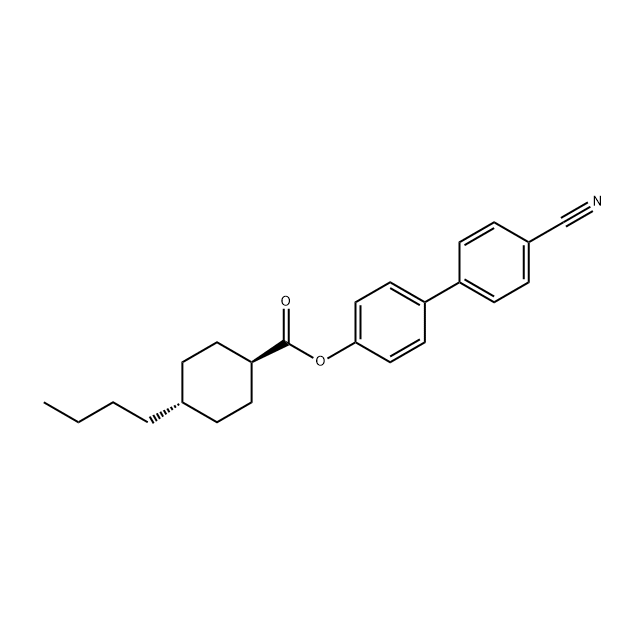
|
CAS NO.67284-58-6 4′-Cyano[1,1′-biphenyl]-4-yl trans-4-propylcyclohexanecarboxylate |
|
|
Product Name |
4′-Cyano[1,1′-biphenyl]-4-yl trans-4-propylcyclohexanecarboxylate |
|
Synonyms |
Cyclohexanecarboxylic acid, 4-butyl-, 4′-cyano[1,1′-biphenyl]-4-yl ester, trans- |
|
CAS NO. |
67284-58-6 |
|
Appearance |
White solid |
|
Purity |
95% min |
|
MF |
C24H27NO2 |
|
MW |
361.48 |
|
Storage |
Preserve in a well-closed container and keep in cool, dry place, avoid light. |
|
Package |
In fluoride bottle/ Fluoride drums/iron drums/plastic drums/IBC Tank ,etc. |
|
Shipment method |
By Sea, Air, Courier door to door, etc. |
|
Loading Port |
China any port, Beijing, Shanghai, Hong Kong etc. |
|
Application |
1.Liquid Crystal Formulating Monomer:This trans-cyclohexane cyanobiphenyl ester monomer has positive dielectric anisotropy. It increases the clearing point of mixed liquid crystals, optimizes dielectric parameters and lowers rotational viscosity, significantly improving the electro-optical response performance of TN and STN mixed liquid crystal systems. 2.Low-temperature Modifier for Mixed Liquid Crystals :It serves as an essential blending component for small-size display liquid crystals. It widens the mesophase temperature range, inhibits liquid crystal crystallization at low temperatures, and ensures stable operation of automotive screens, instrument displays and industrial LCD modules under cold conditions.3.Synthetic 3.Intermediate of Reactive Mesogen (RM):With rigid cyanobiphenyl mesogenic structure, it is a key raw material for synthesizing ester-type reactive mesogens. It provides excellent molecular orientation property, widely used in UV-curable liquid crystal polymers and anisotropic optical retardation films. |
|
Contact |
Contact person: James Zhang Email: james.zhang@dakenchem.com |
Frequently Asked Questions:
Q1: What are the primary applications in liquid crystal displays? (Applications)
Thanks to its extended cyanobiphenyl mesogen, this compound provides exceptionally high optical anisotropy (Δn) and strong positive dielectric anisotropy (Δε). It is routinely incorporated at 5–20% into nematic liquid crystal mixtures for smartphones, automotive dashboards, tablets, and industrial instrument panels. Its ability to boost the mixture’s clearing point while maintaining a wide nematic range makes it ideal for high-contrast displays operating in demanding thermal environments.
Q2: Can it be used to synthesize reactive mesogens (RMs)? (Applications – RM)
Derivatizing 4′-Cyano[1,1′-biphenyl]-4-yl trans-4-propylcyclohexanecarboxylate with acrylate, methacrylate, or other polymerizable groups yields reactive mesogens (RMs) with strong optical and thermal performance. These RMs are used to fabricate quarter-wave plates, patterned retarders, brightness enhancement films, and cholesteric layers for OLED, 3D display, and security features. The trans-cyclohexane spacer ensures low cross-linking shrinkage and fine pattern fidelity, critical for advanced optical devices.
Q3: What are the key performance advantages of this compound? (Performance)
The performance profile of this cyanobiphenyl ester is tuned for modern LC formulations:
- High Δn (>0.18) reduces cell gap requirements, accelerating response.
- Strong positive Δε (>+12) lowers driving voltage.
- Trans-cyclohexane ring imparts a low viscosity and broad smectic suppression.
- Excellent solubility in commercial LC hosts prevents phase separation at low temperatures.
These properties translate directly into brighter, faster, and more energy-efficient displays.
Q 4: What are the key physical properties (melting point, solubility)? (Performance)
Melting point: typically 88–94 °C (exact value provided per batch COA).
Solubility: freely soluble in THF, chloroform, toluene, ethyl acetate; slightly soluble in hexane; insoluble in water.
Thermal stability: TGA demonstrates stability beyond 200 °C, offering a broad processing window. Its high crystallinity facilitates purification to extremely low ionic content (<10 ppb Na⁺), essential for reliable display operation.
Q 5: What packaging and shipment options are available? (Storage & Transport / Procurement)
Standard packages include 100 g / 500 g / 1 kg HDPE bottles with nitrogen purging, 5 kg / 10 kg vacuum-sealed aluminium foil bags, and 25 kg fibre drums with PE liners. For large-scale production, we can supply in super-sacks or custom bulk containers. The product is not classified as dangerous goods under UN transport regulations, simplifying air, sea, and courier logistics. Temperature recorders and cold-chain options are available upon request.
Application Cases:
Case1:High-Birefringence Dopant for Ultra-Fast TFT-LCD Mixtures
4′-Cyano[1,1′-biphenyl]-4-yl trans-4-propylcyclohexanecarboxylate is a prime high-Δn dopant for nematic mixtures used in premium smartphones, gaming monitors, and 8K TVs. Its extended cyanobiphenyl core delivers Δn > 0.20, allowing thinner cell gaps (≤3 µm) for sub-5 ms response times. Formulators blend it at 8–15 wt% to boost brightness and contrast without compromising the nematic range.
Case2:Optical Compensation Film via Reactive Mesogen (RM) Precursor
Derivatized with an acrylate group, this cyanobiphenyl ester forms a polymerizable reactive mesogen with intrinsic high birefringence. The resulting RM is spin-coated and photo-aligned into patterned quarter-wave plates and retardation films for OLED circular polarizers and foldable displays. Its trans-cyclohexane spacer ensures low curing shrinkage and excellent pattern fidelity.
Case 3: High-Contrast Smart Window and PDLC Film Formulation
In polymer-dispersed liquid crystal (PDLC) and polymer-stabilized cholesteric texture (PSCT) smart windows, this compound serves as a high-Δn mesogenic component that maximizes the scattering–transparency contrast. Its strong positive Δε guarantees low driving voltage (<24 V) even at reduced LC loading, while its thermal stability prevents yellowing during the lamination and curing process.
Case4:Wide-Temperature Automotive LCD Formulation
Automotive dashboards and head-up displays must operate reliably from –35 °C to +95 °C. 4′-Cyano[1,1′-biphenyl]-4-yl trans-4-propylcyclohexanecarboxylate contributes high clearing point (>120 °C) and excellent low-temperature miscibility when combined with non-polar diluents. This allows LC mixtures to maintain a nematic phase down to –40 °C without cold crystallization, critical for AEC-Q100 qualified instrument clusters.
Case5:High-Performance Liquid Crystal Polymer (LCP) for 5G Electronics
Incorporating this cyanobiphenyl monomer into side-chain liquid crystal polymers yields low-dielectric-loss LCP films suitable for flexible printed circuits in 5G smartphones and millimeter-wave antenna modules. The rigid trans-cyclohexane structure plus polar cyano group fine-tunes the dielectric constant (Dk) and dissipation factor (Df), enabling signal integrity up to 40 GHz.


